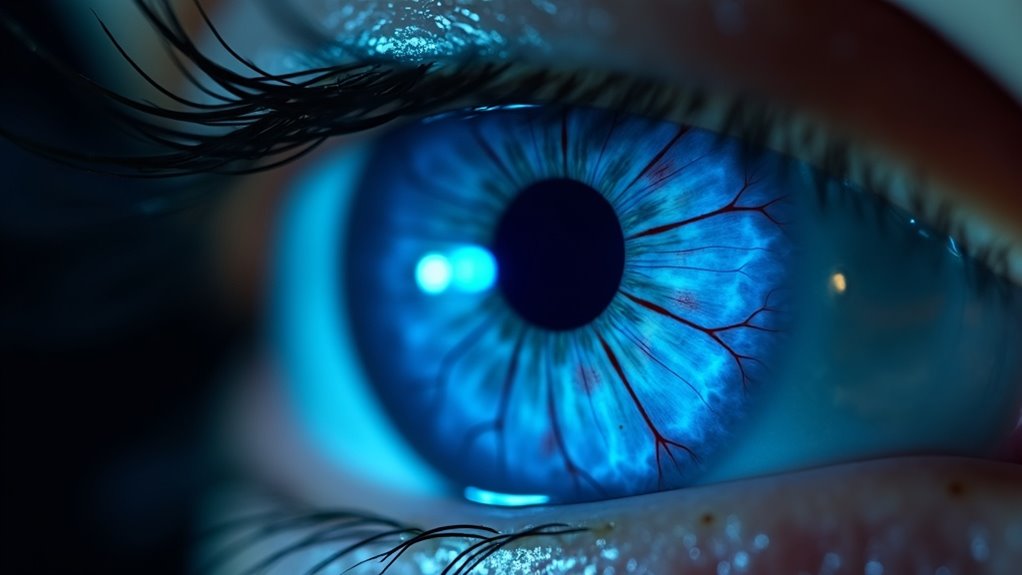


How’s this for a plot twist: the windows to your soul might also be crystal balls for your health. Scientists are discovering that eye scans can predict aging and heart disease risk just as effectively as blood tests. Who knew your eyeballs were such overachievers?
Researchers have found that lens proteins in your eyes accumulate changes over time, creating what’s fundamentally a permanent molecular record of aging. Think of it as nature’s own biological timestamp. Specialized eye scanners can decode these protein signals to measure biological aging without breaking skin or drawing blood. This represents the first study to detect and track biological aging in living humans using spectroscopic measurements of lens proteins.
Your eyes are basically living hard drives, storing an unalterable record of how fast you’re aging at the molecular level.
But wait, there’s more. Retinal blood vessels mirror what’s happening in your entire circulatory system. When those tiny vessels in your retina start showing wear and tear, it’s a pretty good indicator that your heart might be heading for trouble too. Population studies involving over 74,000 participants confirm this connection isn’t wishful thinking. Like the groundbreaking research at Duke Medical Center, these findings are revolutionizing how we monitor cardiovascular health.
Deep learning models are getting scary good at this stuff. They can estimate your “retinal age” with an accuracy of just 2.79 years off your actual biological age. The gap between your retinal age and chronological age? That difference correlates with mortality risk and disease incidence. Yikes.
Here’s where it gets interesting. Eye scans deliver rapid, direct measurements at molecular and cellular levels, while blood tests track composite metrics that are less tied to specific aging mechanisms. PET scans and bone density tests offer indirect assessments that aren’t great for personalized tracking. The research team included investigators from multiple academic institutions spanning Boston University, Harvard Medical School, and the University of Washington.
The UK Biobank and other massive studies with 80,000+ participants validate retinal age as a legitimate aging biomarker. Healthy people show close alignment between retinal and chronological age. Bigger gaps? That signals health problems ahead.
Scientists are also exploring eye movement changes as developmental biomarkers and investigating ocular changes as early warning signs for Alzheimer’s and cognitive decline. Your eyes apparently have a lot to say about your health.
The technology promises point-of-care implementation that’s objective, safe, and comparable to established clinical biomarkers. So next time someone tells you they can see your future, they might actually be onto something. Just not in the way you’d expect.