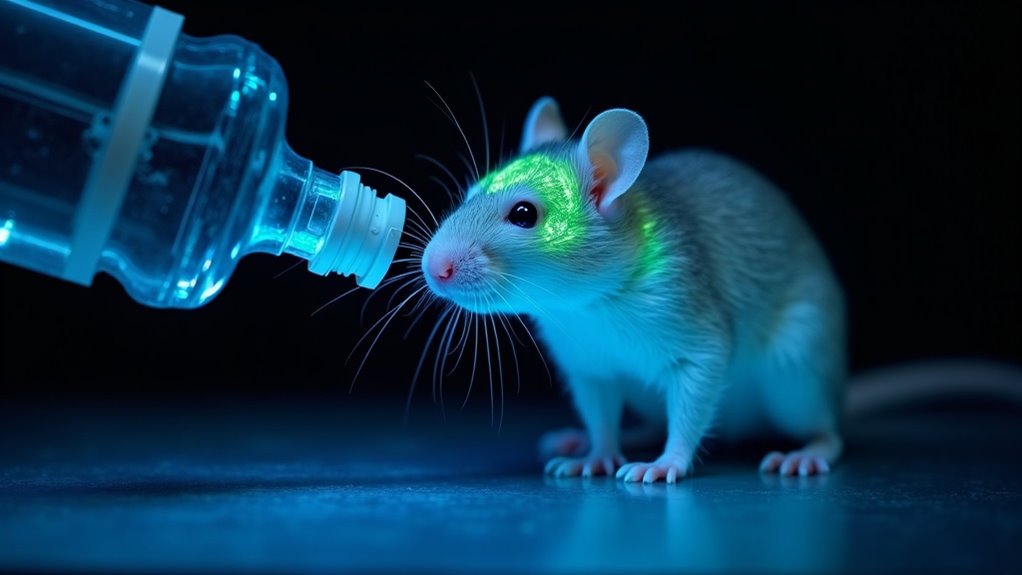
Despite water being essential for life, the mouse brain has evolved an intricate fail-safe system to prevent a potentially deadly mistake: drinking too much.
Scientists have identified a sophisticated neural circuit that acts like an emergency brake on thirst. The system kicks in within seconds of drinking, stopping animals from guzzling themselves into dangerous overhydration. It’s basically the brain’s way of saying “whoa there, buddy.”
The circuit starts with two specialized brain regions that monitor hydration status: the subfornical organ and organum vasculosum laminae terminalis. These areas sit outside the blood-brain barrier, giving them direct access to measure sodium levels in the bloodstream. Think of them as the body’s internal salt detectors.
When dehydration strikes, these sensors send alarm signals to the median preoptic nucleus, which serves as mission control for thirst. The MnPO integrates all the incoming distress calls and fires up the drinking behavior. Without it, even desperate animals won’t drink a drop.
But here’s where things get interesting. The moment an animal starts drinking, inhibitory neurons in the MnPO slam on the brakes. These cells specifically respond to liquid flowing through the mouth and throat during swallowing. They don’t care about solid food, just fluids.
This rapid shutdown happens roughly 10 to 15 minutes before blood actually gets rehydrated. It’s pure anticipation, like your brain trusting that the water heading down will eventually reach your bloodstream. The alternative would be catastrophic overdrinking. Similar to how spatial transcriptomics helps map complex biological processes, these neural pathways reveal intricate cellular interactions controlling thirst.
The system uses multiple backup sensors. Receptors in the mouth detect fluid contact. Stretch receptors in the gut sense fullness. Cranial nerves relay information from the tongue, mouth, and throat back to the brain’s thirst headquarters.
Meanwhile, hormonal backup arrives through the vasopressin system. When overhydration threatens, arginine vasopressin release gets suppressed, reducing water retention in the kidneys. Remarkably, researchers found that altering activity in specific amygdala neurons can prompt drinking even when animals are already full or feeling unwell, demonstrating how neural circuits can override normal satiety signals.
The entire network represents millions of years of evolutionary fine-tuning. Because apparently, even something as simple as drinking water requires rocket science-level neural engineering to avoid disaster. The research was led by the Yuki Oka lab at Caltech, with graduate student Vineet Augustine serving as the lead author.