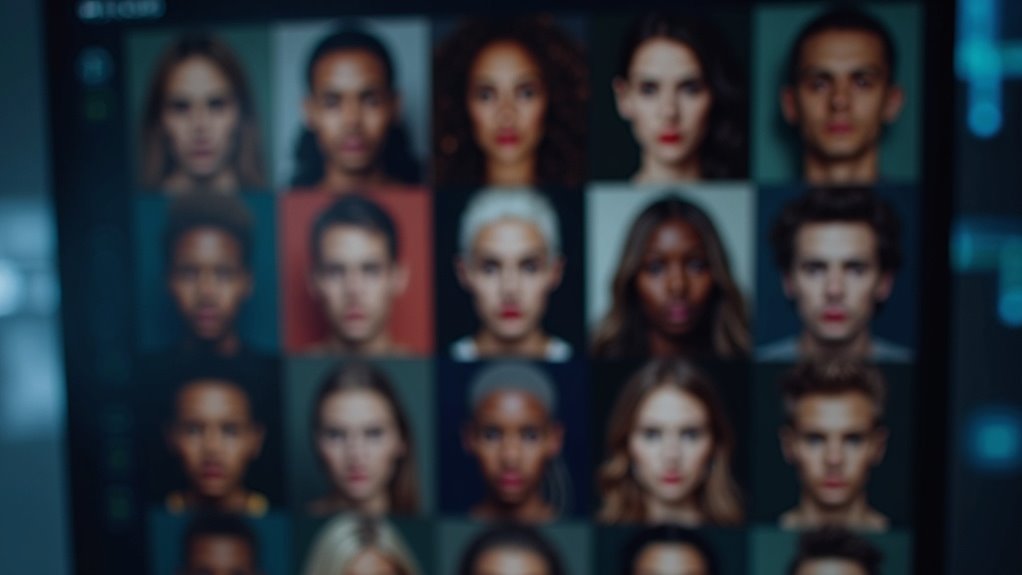

In a world where artificial intelligence can whip up faces that look strikingly real, humans are struggling to tell the difference. Seriously, it’s like a game of “Guess Who?” but with higher stakes. On average, people can only tell real faces from AI ones about 50% of the time. That’s not exactly a stellar score. Some folks do a little better, with accuracy ranging from 48.2% to 58.4%, but let’s be honest—that’s barely above flipping a coin.
Interestingly, not even the so-called super-recognizers—those rare individuals with exceptional face-identifying skills—are immune to this struggle. They’re hitting a dismal 31% to 41% accuracy rate. That’s right. These face wizards can’t even spot a faker half the time.
Even super-recognizers, the elite face experts, are only right 31% to 41% of the time in spotting AI fakes.
It gets even trickier with different AI generation methods. Faces created by GANs? Those are flunking at 48.0%. Meanwhile, diffusion-generated faces are the overachievers, managing 62.1%. StyleGANs specifically focus on generating faces that often appear indistinguishable from real ones.
You think training might help? A brief five-minute session can boost typical participants up to 51%, which is still pretty sad. Super-recognizers with training? They can hit around 64%. Who knew spotting a fake face required a little practice? Apparently, it’s not just about who you are; it’s about how well you can recognize objects too. That’s the real kicker. Object recognition skills are the best predictors of success in spotting AI faces, leaving traditional factors like intelligence in the dust.
And let’s not overlook the ethnic disparities. AI faces of South Asian descent are easier to spot at 60%, while White faces lag behind at 52.9%. It’s almost as if the AI has its preferences, and it’s not afraid to show them.