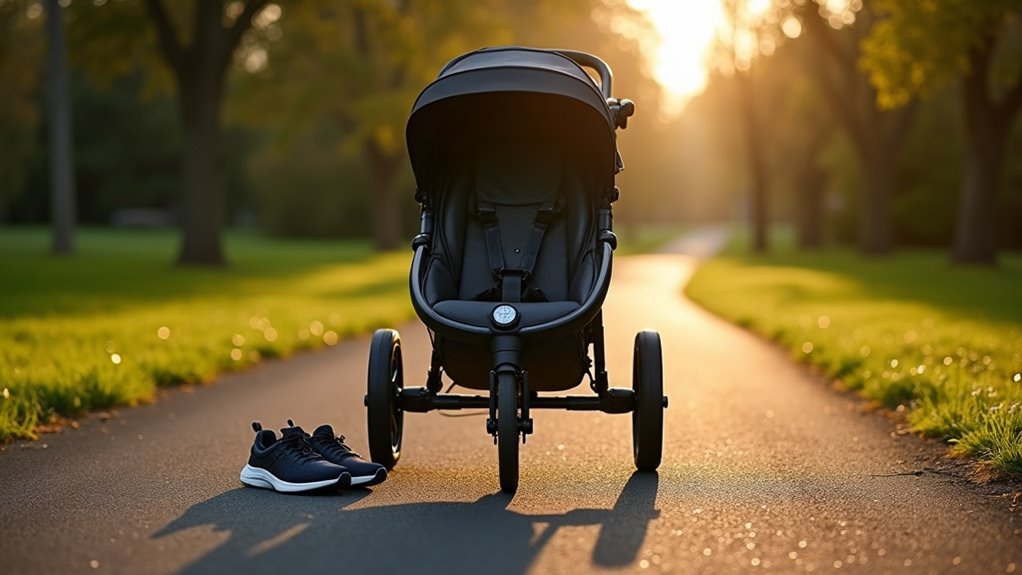

While most runners assume pushing a stroller makes everything harder, new research reveals a surprising twist: stroller running actually reduces injury risk in some key areas.
Scientists discovered that stroller running decreases vertical impact peak by 8–17% compared to regular running. That’s a significant drop. The vertical loading rates—those forces that hammer your bones with every footstrike—are significantly reduced. Your tibial acceleration also decreases slightly, which sounds technical but basically means less pounding on your shins.
This isn’t just academic number-crunching. Lower vertical loading metrics translate to reduced risk of those annoying overuse injuries that plague runners everywhere. We’re talking runner’s knee, shin splints, stress fractures—the usual suspects that sideline runners for weeks or months.
The mechanism seems straightforward enough. Runners pushing strollers absorb impact differently, possibly altering their footstrike patterns. Some adopt a more anterior or extreme rearfoot strike, which helps mitigate impact loading. The cumulative force on bones per stride drops, creating less wear and tear over time. Just as physical strength is crucial for nurses during long shifts, runners need endurance to maintain proper form while pushing strollers.
But here’s where things get interesting—and complicated.
While stroller running reduces vertical forces, it cranks up torsional loading by over 400%. That’s not a typo. The peak free moment and impulse skyrocket when you’re pushing that three-wheeled contraption. Greater foot twisting occurs at push-off, introducing entirely new injury risks.
So you’re trading one set of problems for another. The decreased risk of impact-related overuse injuries gets balanced against increased risk for tibial stress fractures and other twist-related injuries. It’s biomechanical whack-a-mole.
Most studies show stride length remains constant at matched speeds during stroller running, though some report reductions at higher speeds. The modified kinematics affect both injury risk and running economy in ways researchers are still untangling.
The takeaway? Stroller running isn’t the injury-inducing nightmare many assume. It shifts your injury risk profile rather than necessarily increasing it. Impact force reductions of 16% have been documented in practical assessments, which is substantial for anyone dealing with chronic impact-related pain. These findings could revolutionize stroller design by informing more ergonomic features that work with the body’s natural biomechanics.
The research suggests stroller runners need specific injury prevention strategies targeting those elevated torsional forces while capitalizing on the reduced vertical loading benefits. Maintaining an upright posture throughout your run can help minimize the overall injury risk that comes with the forward-leaning tendency many stroller runners develop.