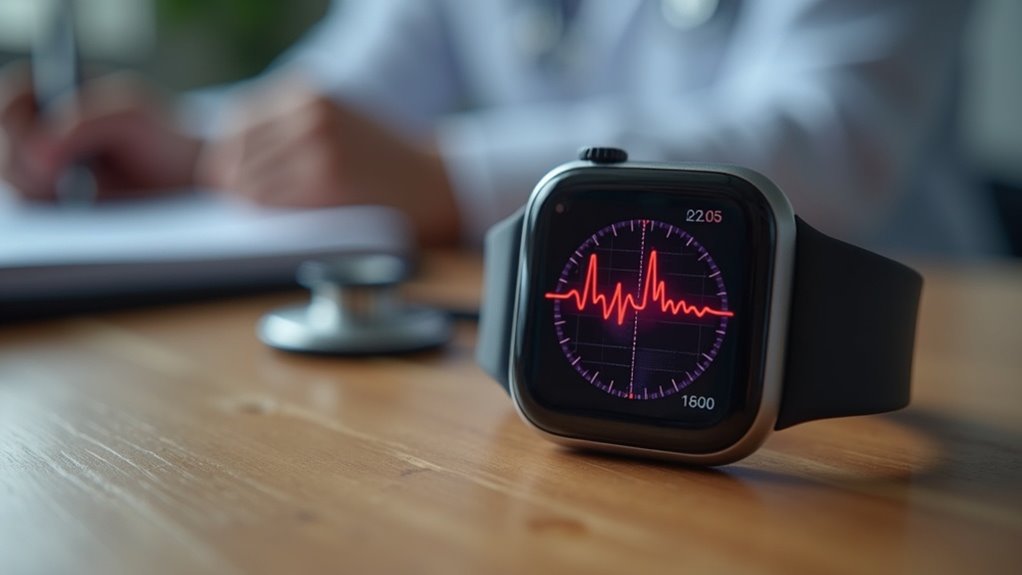

In a world where smartwatches are practically glued to our wrists, they’ve stepped up as unexpected allies in the battle against heart arrhythmias. Seriously. These tiny gadgets are more than just fancy timepieces; they’re packing some serious diagnostic power. With a pooled sensitivity for cardiac arrhythmias hitting a staggering 100%, who wouldn’t want one? And let’s not forget the 95% specificity. That’s right—these devices are getting it right most of the time.
The magic lies in their detection mechanisms. They use photoplethysmography (PPG) to track heart rhythms by shining a light through the skin. Yeah, it sounds like sci-fi, but it works. Studies show that PPG can achieve about 96.1% accuracy in detecting atrial fibrillation. Pair that with on-demand ECG recordings, and you’ve got a recipe for success. Additionally, the importance of early recognition of AF cannot be overstated, as it significantly reduces the risk of strokes and other complications. Completion of formal training is essential for healthcare providers to interpret these readings accurately.
Yet, it’s not all rainbows and butterflies—accuracy can dip depending on device model and user posture. So, good luck with that during a workout. Wearable ECG technology enables patients to capture their heart activity during symptomatic episodes, further enhancing their ability to monitor health.
Clinical studies are buzzing about their effectiveness, too. The Apple Heart Study alone involved over 400,000 participants. Impressive, right? They found an 84% positive predictive value for irregular pulse notifications. However, let’s not ignore the fact that manual review is still needed in 25% of cases. Is it really that reliable, then?
In real-world settings, smartwatches outperformed standard care by detecting arrhythmias four times more often. In a trial involving older adults, the Apple Watch spotted 21 diagnoses, with a whopping 57% being asymptomatic.
But here’s the kicker: notifications can sometimes be alarmingly unnecessary. Slow heart rates during deep sleep? Not exactly life-threatening.