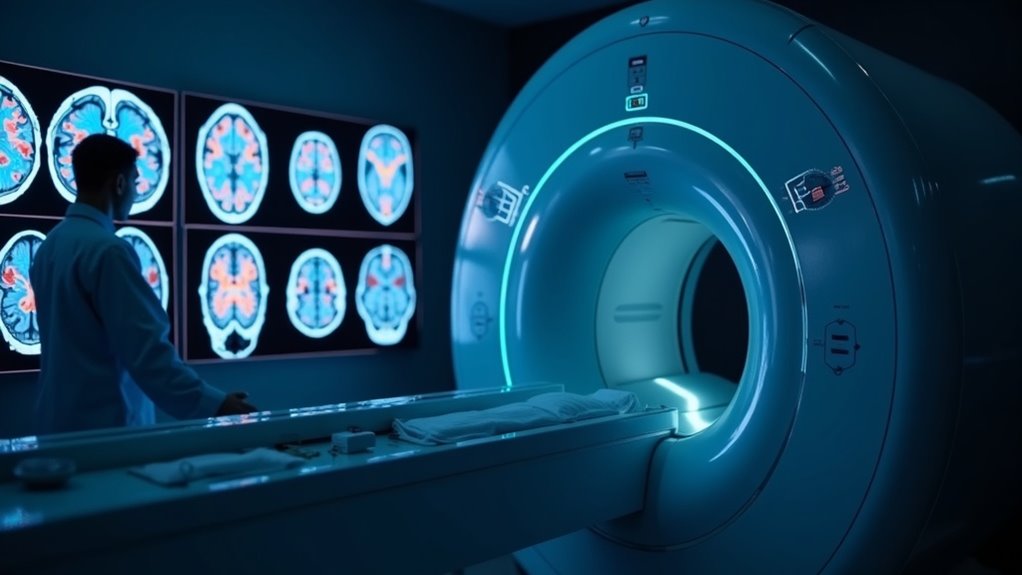

In a world where brain disorders can feel like a game of hide-and-seek, Foundation AI is stepping up to the plate. This isn’t just any tech; it’s a model pre-trained on nearly 49,000 brain scans. Yep, you heard that right. Thanks to some fancy self-supervised learning, it’s got a grasp on how our brains are put together and how they misbehave. Unlike your run-of-the-mill MRI algorithms, Foundation AI uses a contrastive learning approach. This means it doesn’t just predict one outcome—it’s got its fingers in multiple pies.
Foundation AI is revolutionizing brain disorder diagnostics with its innovative model trained on nearly 49,000 scans, mastering the complexities of our minds.
The model’s not just for show. It’s already being used by various research groups to tackle serious issues like Alzheimer’s, autism, and even brain tumors. Just think about that! It can predict brain age with a mean absolute error of just 6.55 years. That’s better than what most of us can guess about our own age after a few late nights.
And when it comes to predicting time-to-stroke, it’s got a mean absolute error of only 38.87 days. That’s pretty impressive. Now, here’s the kicker: it requires up to ten times less training data than traditional models. So, if you thought you needed heaps of data to get anywhere, think again. It’s adaptable, needing just a little fine-tuning to identify important neurobiological markers, making it especially effective for early diagnosis of neuropsychiatric conditions. Furthermore, its ability to decode complex fMRI data positions it as a frontrunner in advancing precision diagnostics.
And the performance? Off the charts—outdoing specialized models in most cases. The potential for clinical application is huge. Imagine integrating this tech into existing medical workflows. It could automate analysis of brain imaging data like a boss. But let’s be real. With great power comes great responsibility.
The promise is tantalizing, but the pitfalls are there too. The stakes are high, and so is the need for caution. Foundation AI might just change the game, but it’s a game that needs careful playing.