

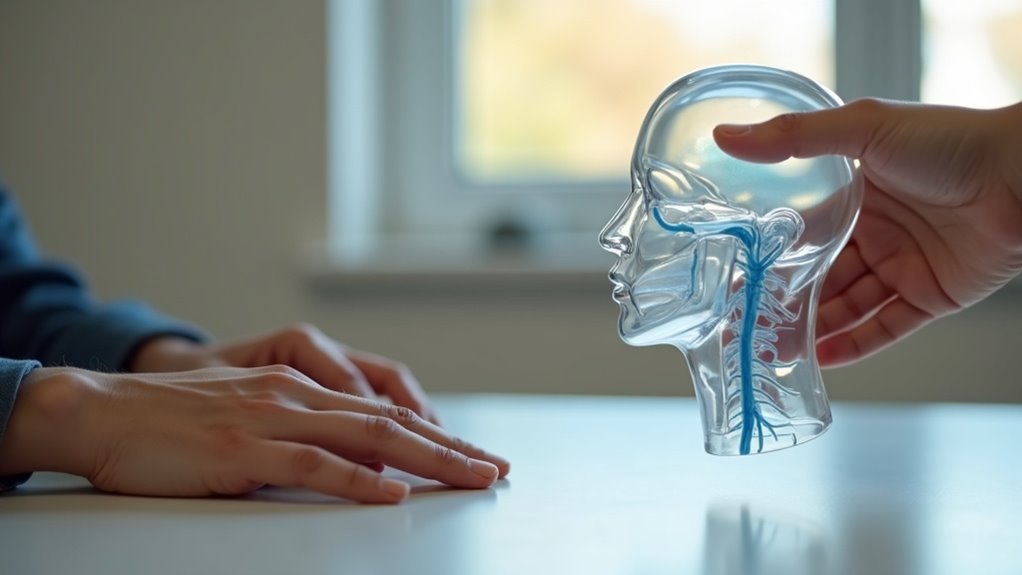
Most people unconsciously reach for their faces dozens of times throughout the day, completely unaware they’re engaging in what scientists call spontaneous facial self-touching, or sFST for short. Turns out, this seemingly mindless behavior might be revealing more about internal stress levels than anyone realized.
Research shows that face-touching frequency skyrockets during periods of cognitive stress. When anxiety, discomfort, or uncertainty creep in, hands gravitate toward the nose, chin, and cheeks—usually with the non-dominant hand. It’s not random fidgeting. This behavior correlates strongly with sympathetic nervous system overactivity, a clear physiological marker of stress. During the current respiratory virus season, transmission risks have made understanding face-touching behaviors even more critical for public health.
Face-touching isn’t random fidgeting—it’s your sympathetic nervous system broadcasting internal stress through unconscious hand movements toward your features.
In workplace studies, sFST proves more reliable for detecting stress than facial expressions, especially during solitary cognitive tasks. People can fake a smile, but they can’t easily fake their unconscious touching patterns. The face becomes a stress barometer, broadcasting internal turmoil through brief touches lasting less than three seconds each. Researchers analyzed nearly 170 hours of real-world office recordings to establish these behavioral patterns.
But here’s where it gets interesting: sFST isn’t just a stress signal—it’s actually a coping mechanism. This evolutionarily-rooted behavior serves as self-soothing, helping regulate psychological and physiological stress responses. The face contains dense nerve clusters, making it prime real estate for rapid comfort through touch. Studies show touch generally reduces cortisol levels and improves anxiety symptoms.
The cognitive benefits are surprising. People who frequently engage in sFST show improved memory retention. When researchers suppressed face-touching during cognitive tasks, high-frequency touchers performed markedly worse on memory tests. Their brains apparently rely on this behavior to manage interference during working memory tasks. Scientists have identified measurable changes in brain wave patterns across different frequency bands when people attempt to inhibit their natural face-touching behaviors.
Laboratory evidence reveals measurable neurophysiological changes occurring immediately before and after sFST episodes. Suppression creates distinct neurological profiles compared to permitted self-touch, reinforcing its regulatory importance. Real-world studies using video analysis, thermal imaging, and heart rate monitoring confirm the strong association between sFST and stress markers.
Even primates exhibit facial self-touching during emotional or cognitive challenges, suggesting this stress-buffering response is conserved across species. So the next time someone unconsciously touches their face during a difficult conversation or challenging task, they’re not just being fidgety—they’re employing an ancient survival mechanism.