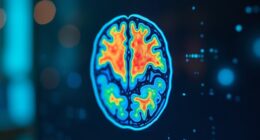
Consciousness is that elusive thing we all experience but can’t quite pin down. It’s like trying to catch smoke with your bare hands. Scientists have been on a quest to understand the Neural Correlates of Consciousness (NCCs). It’s more complicated than flipping a light switch. Researchers have found that NCCs aren’t just about neurons firing haphazardly; it’s all about those precise spiking patterns.
Take medial temporal neurons, for example. They keep buzzing even when we’re not consciously aware of something. Pretty cool, right?
Let’s talk about the thalamus. This little guy is a gatekeeper, controlling what stimuli get to our conscious minds. It’s like a bouncer at a club, deciding who gets in and who doesn’t. Meanwhile, high-gamma activity in the occipitotemporal cortex keeps our conscious thoughts alive, like a loyal pet that won’t leave your side.
Here’s where it gets spicy: attention and consciousness aren’t the same thing. You can focus without truly experiencing something. Studies show that brain activity spikes more for consciousness than for attention. Who knew our brains had layers? Neural signaling through action potentials reflects how spiking patterns correlate with conscious experience, indicating the complexity of neural interactions.
And don’t get me started on the prefrontal cortex. It’s not just there for show. It supports conscious awareness and those pesky metacognitive judgments we all love to hate. Interestingly, human intracranial recordings provide a unique perspective on how different brain regions interact during conscious experience.
But wait, there’s more! Experimental evidence from ECoG studies and fMRI scans challenges our understanding. It’s like peeling an onion—layers upon layers of complexity. Some researchers are pushing new models to explain consciousness, like a four-phase process involving a “pulse” of activity. Sounds fancy, doesn’t it?
As we dive deeper, gaps in our understanding remain. We’re left with more questions than answers. Are we wrong about consciousness? Maybe. One thing’s for sure: the neural mechanisms behind our experiences are anything but straightforward.