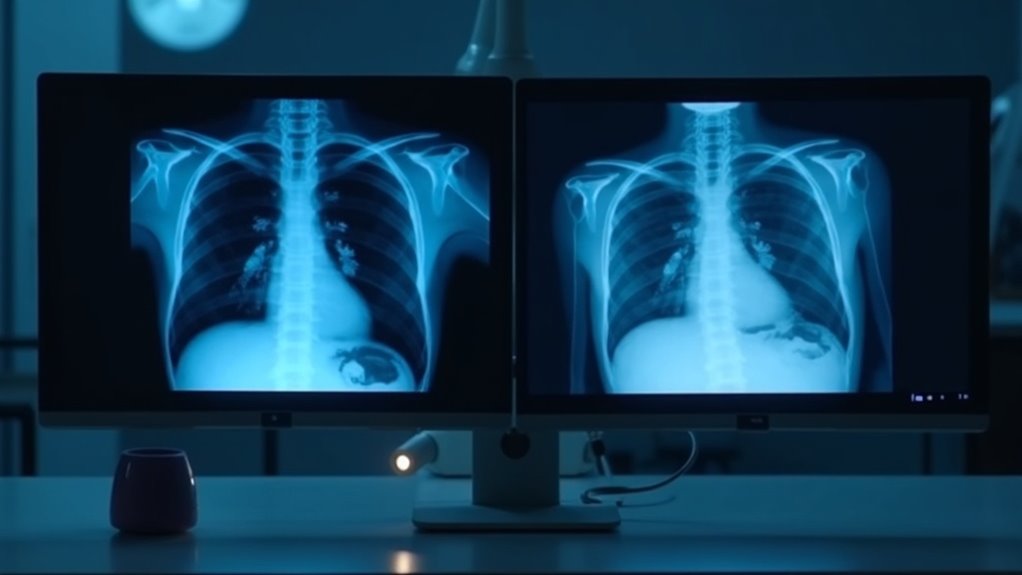
Increasingly, artificial intelligence is stepping into the world of medical imaging with all the confidence of a first-year med student—and roughly the same diagnostic accuracy.
AI crashes into medical imaging with freshman overconfidence and coin-flip diagnostic skills to match.
A thorough study reveals that generative AI models hit diagnostic accuracy rates of just 52.1%. That’s barely better than flipping a coin. When pitted against non-expert physicians, AI managed to squeeze out a measly 0.6% advantage. Not exactly revolutionary.
Expert physicians? They crushed AI by 15.8%. The machines weren’t even close.
But here’s where things get interesting. Models trained on synthetic medical images performed just as well as those fed real data. Adding fake images to training sets actually boosted performance across multiple tests. Low-prevalence conditions saw the biggest improvements when synthetic data joined the party.
The anatomical accuracy results read like a report card from hell. Text-to-image generators stumbled through basic anatomy with embarrassing inconsistency. Bing and Gemini nailed heart images while competitors face-planted. Only Gemini got sternum and rib structures right. Hand skeleton illustrations? Anatomically correct solely with Gemini.
Surprisingly, all platforms reproduced human brains accurately overall. Small victories.
Medical education sees promise, but AI-generated images currently lack the precision of skilled illustrators. Bony structures and subtle details remain problematic. The technology accelerates illustration processes but can’t replace human expertise. Yet. Remote patient monitoring technologies are revolutionizing how healthcare providers track patient outcomes and detect early warning signs. Researchers achieved this breakthrough using a denoising diffusion probabilistic model trained on the massive CheXpert chest X-ray dataset. Individual studies have shown that generative AI excels at processing vast medical literature and patient information with remarkable speed.
The fairness angle offers hope. Synthetic data helps reduce training bias, especially for underrepresented groups. Models using combined real and synthetic images with minimal demographic encoding performed more fairly across diverse clinical settings. Targeted de-biasing techniques improved diagnostic fairness markedly.
Most studies analyzing these AI systems carried high risk of bias, potentially skewing results. That’s not reassuring when discussing medical applications.
The bottom line? AI-generated medical images show promise as supplementary tools but fall short of replacing human expertise. Models like Gemini and GPT-4o demonstrate performance matching general medicine AI tasks, yet expert physicians remain superior diagnosticians.
Combined real and synthetic data training produces the most robust results. However, relying solely on synthetic images risks missing subtle clinical nuances. Continuous evaluation and expert oversight remain essential for any educational or clinical applications.