
In a world where concussions are as common as bad decisions at a high school party, researchers are stepping up their game. Enter the domain of AI voice diagnosis, where your voice could literally save your brain.
For the past decade, Poellabauer has been on a mission, diving deep into voice correlation studies tied to traumatic brain injuries. He’s collected voice samples from high school and college athletes, covering sports that make parents cringe—boxing, football, lacrosse, rugby, and cheerleading.
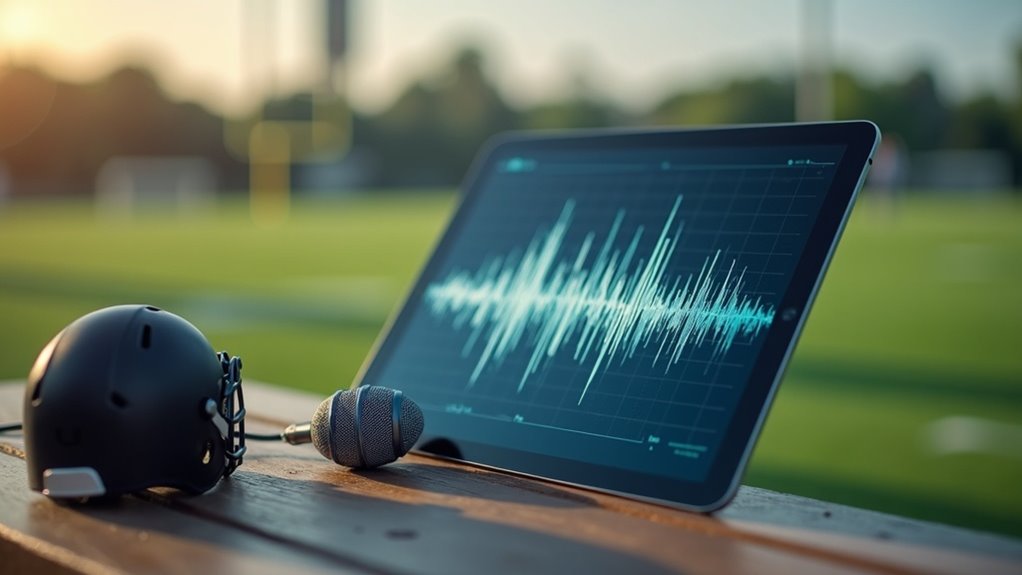
What’s the big deal? This isn’t just some half-baked idea. The research boasts over 90% accuracy in detecting concussions through changes in voice. Yup. AI can pick up on those subtle shifts in amplitude and frequency that you’d miss even if you were paying attention.
This isn’t just a gimmick; AI detects concussions with over 90% accuracy by analyzing your voice’s subtle shifts.
And it gets better. The PaTaKa test? It’s practically a superhero when it comes to identifying concussed from non-concussed individuals.
You think it’s too soon for a diagnosis? Nah. With a pre-season baseline stored on a tablet, this tech compares voice samples post-incident. It can gauge the severity of an injury faster than you can say “CTE.” In fact, more than 50% of concussions in the U.S. remain undiagnosed, highlighting the urgent need for effective detection methods. This technology could potentially help address the alarming statistic of 50% to 90% of concussion cases going undiagnosed in emergency settings.
The automated AI doesn’t just stop there; it integrates with visual and cognitive assessments. Talk about a multitasking marvel.
But wait—there’s more. This isn’t just a one-trick pony. Researchers are eyeing broader applications for conditions like Parkinson’s and Alzheimer’s. That’s right; your voice could potentially help in detecting mild cognitive impairment in under three minutes.