
For years, scientists thought GluD proteins were just sitting around in the brain, doing absolutely nothing—like that friend who shows up to a party but never leaves the couch. Turns out, they were dead wrong. Recent research from Johns Hopkins Medicine revealed that GluD proteins are actually active players in the brain, regulating synapse formation and function. Synapses are the hotspots where brain cells communicate, so these proteins are far from lazy.
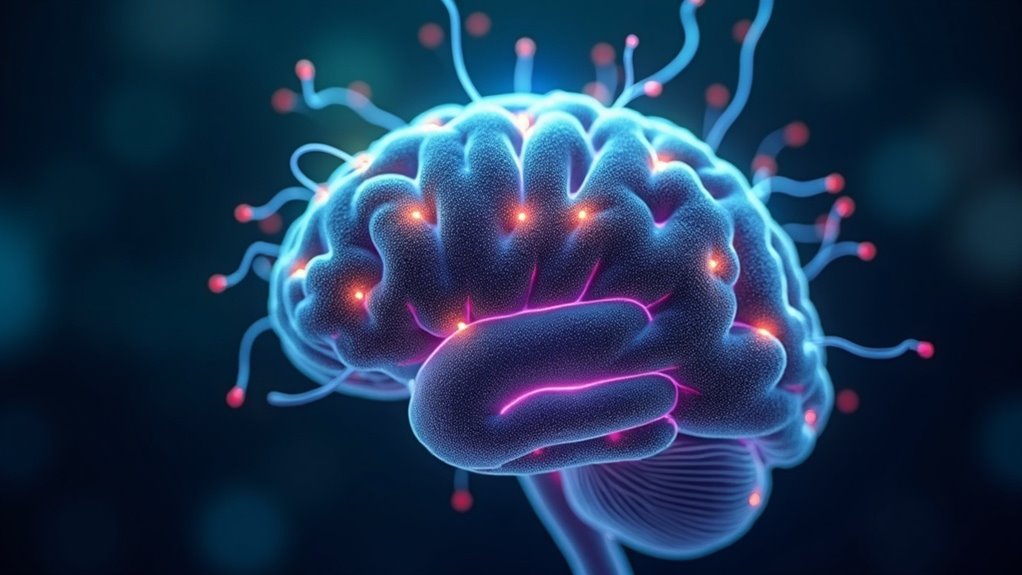
GluD proteins are the brain’s unexpected heroes, actively shaping synapses and sparking communication between neurons.
This revelation is a game-changer. It flips decades of assumptions upside down. GluD activity is essential for thought and memory formation. Imagine discovering your couch potato friend is actually a secret mastermind. That’s what’s happening here.
But it gets wilder. Mutations in GluD proteins have been linked to anxiety disorders and schizophrenia. In people with schizophrenia, GluD levels drop like a bad habit, leading researchers to evaluate boosting their activity as a potential treatment. Who knew couch potatoes could hold the key to mental health?
But wait, there’s more! GluD proteins have also been implicated in cerebellar ataxia, a condition that messes with movement and balance. In this case, rather than being lazy, GluD proteins become hyperactive, causing havoc even without inputs. That’s right, they’re like that over-caffeinated friend who can’t sit still. GluDs are even found to contain charged particles that aid in neurotransmitter binding, showcasing their complex role in cell communication.
And yes, this hyperactivity often comes with memory problems—what a combo! Interestingly, disruptions in sleep patterns can also impact sleep problems and Alzheimer’s risk, revealing another layer of complexity in how GluD proteins may relate to neurological conditions.
As if that’s not enough, these proteins might even help combat age-related memory loss. GluD directly influences the synaptic function vital for forming memories, which tends to decline as we age. Targeting GluD could be a game plan for preserving those precious memories.
In a nutshell, GluD proteins are no longer the wallflowers of the brain. They’re key players in a multitude of conditions, opening doors for new treatments that could reshape psychiatric and neurological care. Who knew a couch potato could be so powerful?