
Facial expressions are more than just quirky facial contortions; they’re a fascinating glimpse into the brain’s inner workings. Ever thought you were in total control of your smile or frown? Think again. Research reveals that both emotional and voluntary facial expressions bubble up from a shared neural network. Surprise! Your brain’s not as compartmentalized as once believed.
Multiple regions of the brain leap into action, cooperating in a beautifully chaotic dance. It’s not a clean separation between “I’m happy” and “I’m pretending to be happy.” No, it’s a mash-up of brain regions, each contributing its own flair. The cingulate motor cortex gets the party started, laying down direct access to facial muscles. Notably, facial expression control begins in the brain stem at the facial nucleus, highlighting the complexity of this process. Recent studies have shown that movement-independent cells linked to an animal’s internal state also play a role in shaping these expressions.
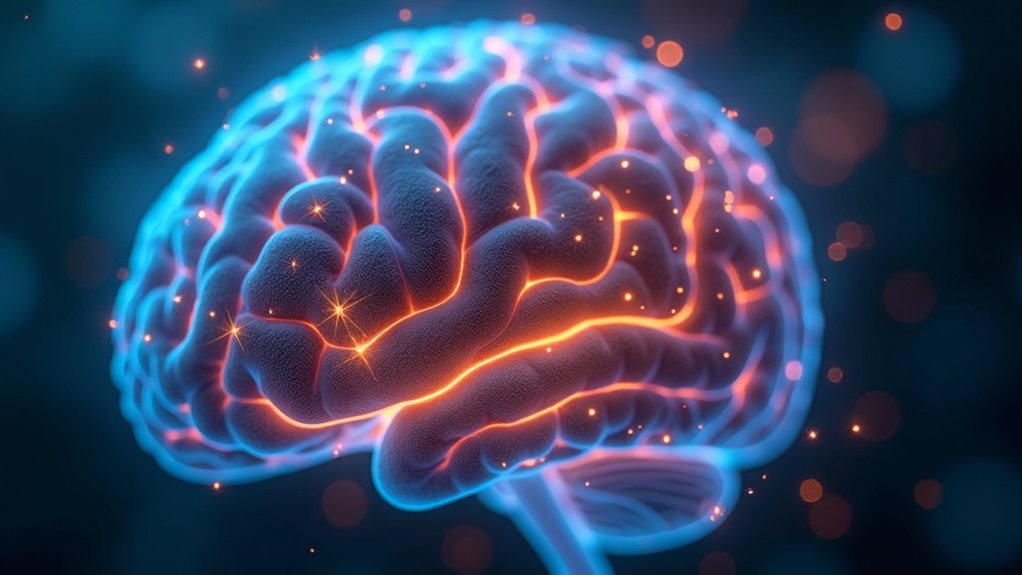
Facial expressions are a chaotic symphony of brain regions, where emotions and pretenses intertwine in a vibrant display.
Meanwhile, the primary motor cortex is calling the shots on actual movements. It’s like a poorly organized team meeting where everyone is involved, but no one knows who’s in charge.
And let’s not forget about the amygdala. This little guy is busy monitoring emotions, throwing in some autonomic responses for good measure. So, while you might think you’re putting on a brave face, your brain is already a step ahead, firing off signals for the real-time adjustments that dictate your expressions.
Hierarchical information flow? Yep, it’s happening. Signals stream from the cingulate cortex down to those motor and sensory areas, like a relay race where the baton never really stops moving.
Different brain regions also have their own rhythms. The lateral motor cortex is your speedy friend, acting fast during movement onset. The somatosensory cortex? A little slower, but still on its toes. Meanwhile, the premotor cortex is a reliable middleman, maintaining steady activity.