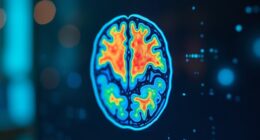
In a world where diagnosing dementia often feels like trying to solve a Rubik’s Cube blindfolded, AI is stepping in to take the blindfold off—at least a bit. This tech wizardry has upped the ante, boosting diagnostic accuracy for dementia by about 26% compared to neurologists flying solo. That’s a big deal! Imagine your doctor confidently identifying nine different types of dementia with an 88% accuracy rate using just one FDG-PET scan. It sounds like magic, but it’s just AI doing its thing.
AI is revolutionizing dementia diagnosis, boosting accuracy by 26% and identifying multiple types with impressive precision.
These smart models don’t stop at identifying types; they predict Alzheimer’s progression with an impressive 82% accuracy. They can even tell if mild cognitive impairment is stable or on a fast track to disaster. That means personalized patient management is no longer a pipe dream. AI can stratify how quickly dementia is progressing—stable, slow, or rapid. It’s like having a crystal ball for patient care.
Let’s talk about the variety. AI isn’t picky; it tackles everything from Alzheimer’s and vascular dementia to more niche types like frontotemporal dementia. Some platforms can distinguish up to ten different dementia types using a mix of clinical data and neuroimaging. And yes, it’s even analyzing movement patterns alongside brain scans. How’s that for multitasking?
The data backing these models is substantial. We’re talking over 50,000 individuals from all over the world. That’s a lot of brains! Independent validation on diverse cohorts adds to the trustworthiness. Additionally, the AI tool integrates patient data to enhance its predictive capabilities.
Plus, AI cuts the time to diagnosis in half. Clinicians can reach conclusions faster, which means earlier interventions. Who wouldn’t want that?
But here’s the kicker: AI can still work with limited data. For low-resource medical settings, that’s a game changer. The potential is enormous, but are clinicians ready for this tech revolution? Only time will tell.