Stroke prediction is no longer just a game of luck or a shot in the dark. With the advent of innovative technology, researchers are diving deep into the world of smart beds and noncontact monitoring. These beds aren’t just comfortable; they keep tabs on heart rates and breathing without bothering anyone. Sounds like a sci-fi dream, right?
But here’s the kicker: when doctors combine this data with lab results, nurse observations, and other static data, the prediction accuracy skyrockets to a jaw-dropping 92%. Yes, you read that right.
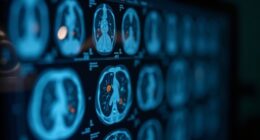
Then there’s the Shunyi model, which mixes clinical and neuroimaging features. It outperforms its peers like R-FSRP and China-PAR, showing that the future of stroke prediction is not just about luck; it’s about smart algorithms that actually work. This model boasts an AUC of 0.85 for predicting strokes over five to seven years, with indicators like cerebral small vessel disease acting as red flags. High CSVD? You might as well start drawing up your will.
Deep learning is shaking things up, too. It generates disconnection metrics that leave traditional stats in the dust. These metrics are not just fancy jargon—they predict long-term outcomes better than anything we’ve used before. Sure, manual lesion delineation is still the gold standard, but automated methods are creeping in. NIHSS is identified as the most important determinant for predicting stroke severity, highlighting the role of clinical data in enhancing prediction accuracy.
Yet, let’s not kid ourselves. Challenges remain. Complex metrics aren’t standard in hospitals yet. Most patients still get CT scans instead of the more informative MRIs. This means the advanced tools we’ve developed might not be utilized to their full potential. It’s frustrating, to say the least.
In the end, while these innovative indicators bring hope, the road to clinical adoption is rocky. It’s a mix of groundbreaking innovation and old-school barriers. So, is it a breakthrough or a mirage? Only time will tell.