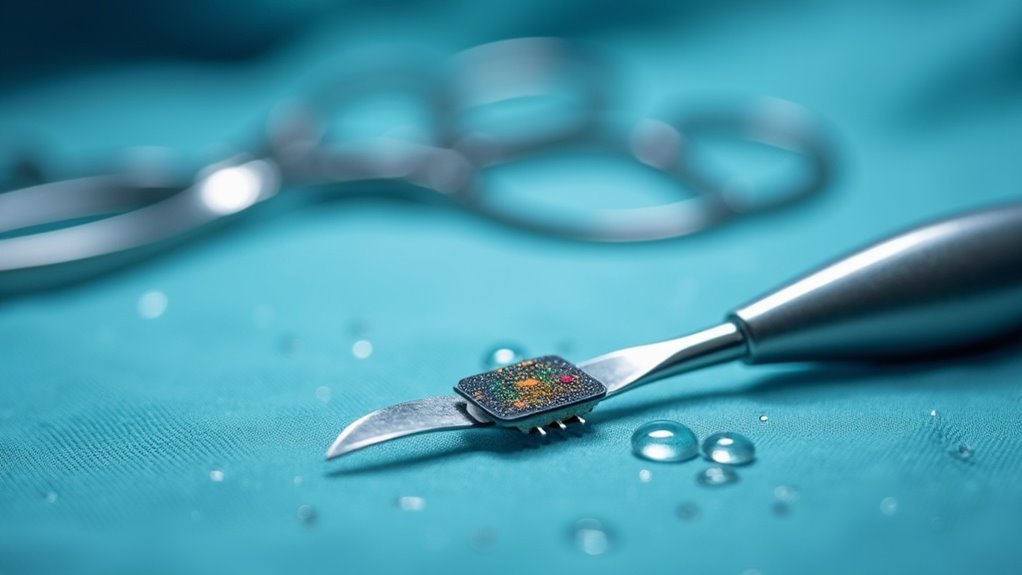


While surgeons have been slicing and dicing with scalpels for centuries, researchers have finally figured out how to make the humble blade do more than just cut. Enter the “Lab-on-a-Scalpel”—because apparently, regular scalpels weren’t fancy enough.
Because apparently, regular scalpels weren’t fancy enough—now they come with built-in chemistry labs for the overachieving surgeon.
This isn’t science fiction. It’s a real electrochemical sensor built right into a standard surgical scalpel handle. The device can detect biochemical markers like epinephrine directly from tissue or fluids during surgery. Real-time diagnostics while you operate? Revolutionary.
The manufacturing process relies on 3D printing technology, combining PLA plastic with conductive carbon nanomaterials. Desktop-sized printers can churn these out on demand. Each disposable sensor costs roughly EUR0.40. That’s cheaper than most hospital coffee.
Performance numbers look impressive. The detection limit for epinephrine hits 0.13 μM—that’s 130 nanomolars for the chemistry nerds. Testing on artificial blood samples showed accuracy ranging from 91% to 105% compared to standard laboratory values. Not bad for something you can literally hold in your hand.
The real advantage? Speed. No more waiting for lab results while a patient lies open on the table. Surgeons get biochemical insights immediately, right in the operating theater. This matters most during high-risk procedures in oncology, emergency medicine, or trauma surgery where every second counts. The research team from the Sofer Group at UCT Prague developed this innovative surgical diagnostic tool. Additionally, the integration of AI in Pharma is expected to enhance such technologies, leading to better decision-making in surgical environments.
Sample volume requirements are minimal. Even tiny fluid amounts work fine. The device uses cyclic voltammetry, amperometry, and differential pulse voltammetry to measure signals. Fancy terms for “it actually works.”
Future developments could expand detection capabilities to include metabolites, electrolytes, and tissue pH. Multiple surgical specialties could benefit from this rapid feedback system. The technology might even integrate with robotic-assisted surgery platforms. The device’s seamless incorporation into existing surgical workflow eliminates the need for training surgeons on entirely new protocols.
The disposable design addresses hygiene concerns while keeping costs manageable. Mass adoption becomes feasible in both well-funded hospitals and resource-limited settings. One less instrument cluttering the operating room, one more diagnostic tool at surgeons’ fingertips.
Laboratory validation provides proof of concept, but the real test comes when surgeons start using these sensor-equipped scalpels during actual procedures. If successful, this could fundamentally change how intraoperative decisions get made.