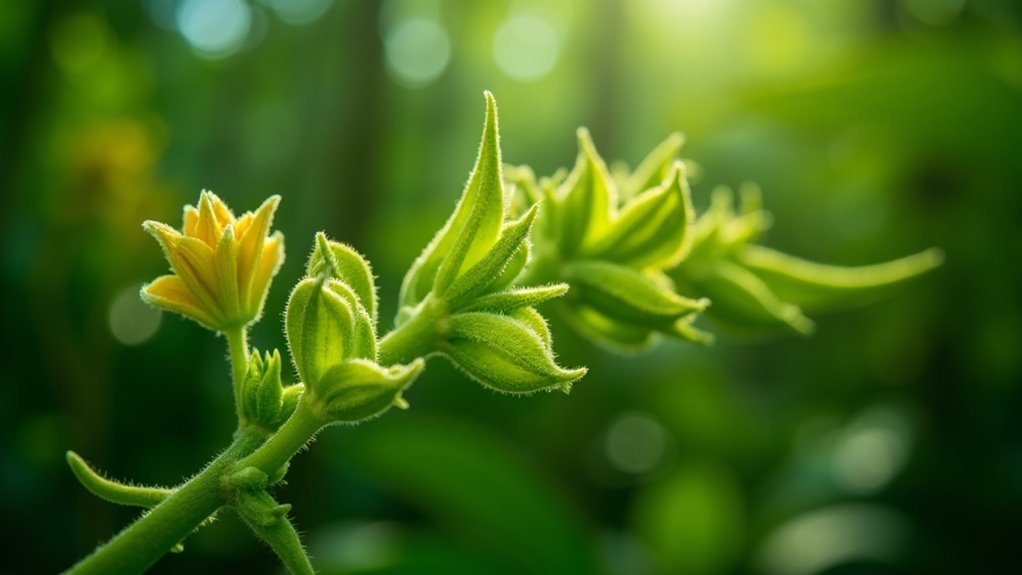
Deep in the Amazon rainforest, a spiky vine called cat’s claw has been quietly producing what might be nature’s next cancer-fighting weapon. The plant, scientifically known as Uncaria tomentosa, churns out a complex alkaloid called mitraphylline. And researchers have finally mapped how it does it.
This isn’t your average plant chemistry. Mitraphylline is a pentacyclic oxindolic alkaloid—basically a molecular maze with the formula C₂₁H₂₄N₂O₄. At 368.4 grams per mole, it’s hefty stuff. The white crystalline compound melts at a scorching 265-272°C and packs serious bioactive punch.
This molecular heavyweight clocks in at 368.4 grams per mole—a crystalline cancer-fighter that doesn’t mess around.
The biosynthesis starts simple enough. Like other indole alkaloids, mitraphylline begins its journey from tryptophan, an amino acid. But from there, things get complicated fast. The exact enzymatic pathway in cat’s claw remains partially mysterious, though researchers suspect multiple enzymes tag-team the process. Cytochrome P450s and methyltransferases likely play starring roles, transforming basic building blocks into this intricate cancer-fighter.
What makes mitraphylline special? It shows genuine antiproliferative activity against cancer cells. Translation: it stops tumors from spreading. The compound also flexes anti-inflammatory muscles, adding another weapon to its therapeutic arsenal. Other Uncaria alkaloids demonstrate neuroprotective and antihypertensive effects, suggesting this plant family means business. Mitraphylline belongs to the corynantheine-heteroyohimbine group, a class of structurally related alkaloids with diverse biological activities.
The research community is paying attention. Scientists are studying mitraphylline in vitro, watching it shut down cancer cell lines with impressive efficiency. Commercial suppliers now offer research-grade material at 98% purity. Storage requirements are strict—keep it cold, dry, and away from light. Laboratory preparations require careful handling, as mitraphylline dissolves in DMF and DMSO at concentrations of 5 mg per milliliter.
But here’s the catch: despite promising preclinical data, mitraphylline hasn’t seen human trials yet. It remains a research chemical, not an approved drug. The FDA hasn’t blessed it for clinical use.
Future work focuses on several fronts. Researchers want complete biosynthetic pathway maps, detailed mechanism studies, and proper toxicology data. Some are exploring synthetic biology approaches to scale up production, because harvesting Amazon vines isn’t exactly sustainable.
The potential is real. Whether mitraphylline becomes the next blockbuster cancer treatment depends on rigorous testing and regulatory approval. For now, cat’s claw keeps its secrets while scientists decode nature’s pharmaceutical factory.