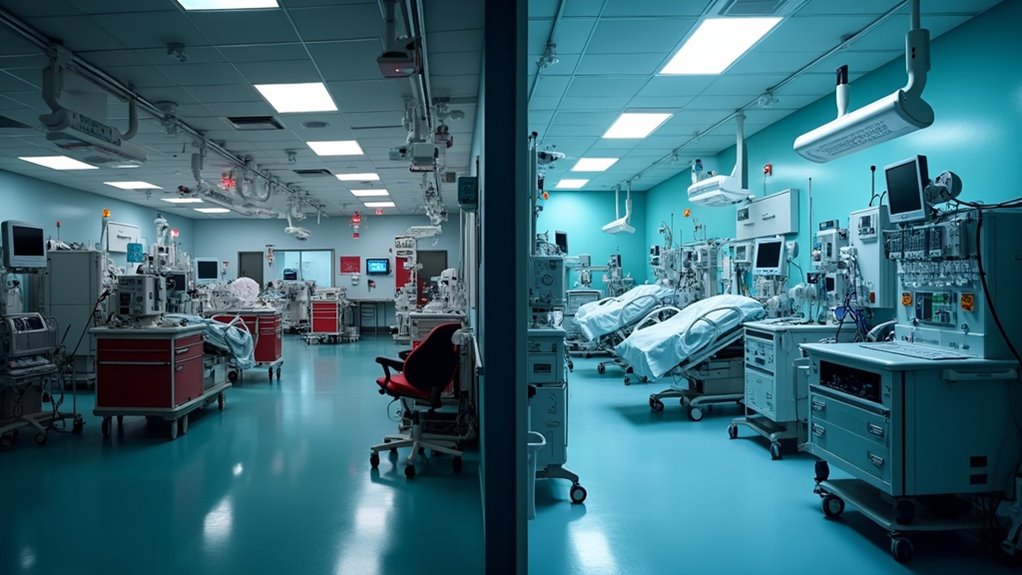

While both emergency medicine and critical care deal with life-and-death situations, they operate in completely different worlds. Emergency medicine is like a high-speed medical assembly line. Doctors see everything from heart attacks to stubbed toes, making split-second decisions with minimal information.
Emergency medicine operates like a high-speed medical assembly line where doctors make split-second decisions with minimal information.
Critical care? That’s more like a medical monastery where specialists obsess over every heartbeat and breath of their sickest patients.
The emergency department is chaos incarnate. Patients flood in with mysterious symptoms, and EM doctors have to figure out who’s dying and who’s just having a really bad day. Fast turnover is the name of the game. Stabilize, diagnose, discharge, or ship them upstairs. Next patient, please.
Critical care operates at a completely different pace. These patients aren’t going anywhere soon. They’re the ones who barely survived their trip through the ED and now need machines to keep their organs functioning. ICU doctors don’t deal with mystery symptoms anymore—they’re managing confirmed disasters like organ failure and sepsis. The multidisciplinary team approach in critical care ensures comprehensive treatment for these complex cases.
Training reflects these different worlds entirely. Emergency medicine residents learn to be medical Swiss Army knives, handling trauma, cardiac arrests, and everything in between. They’re generalists who thrive on variety and speed. Emergency medicine can be pursued through structured training programs directly after MBBS without requiring prior postgraduate specialization.
Critical care specialists? They’re the medical equivalent of Formula One pit crews, masters of ventilators, invasive monitoring, and keeping people alive when their bodies want to quit. Modern artificial intelligence systems assist them in predicting patient outcomes and optimizing treatment plans.
The diagnostic approaches couldn’t be more different. EM doctors grab whatever information they can get quickly—point-of-care tests, rapid imaging, clinical intuition. They make preliminary diagnoses and move on.
CC physicians have the luxury of time and continuous data streams. They can monitor every crucial sign, lab value, and organ function minute by minute.
Procedures tell the same story. Emergency docs do sutures, splints, and emergency airways. Critical care specialists manage mechanical ventilation, dialysis, and complex drug drips.
One specialty is about immediate fixes; the other is about sustained, intensive life support.
Both save lives, but emergency medicine catches people as they fall while critical care slowly builds them back up.